Aramco Work Permit Receiver (WPR) Certificate can be an important qualification for workers who want to apply for industrial, construction, oil and gas, or maintenance jobs in Saudi Arabia. WPR-related roles involve understanding work permits, workplace hazards, safety precautions, and the procedures required before certain jobs can begin.
However, there is an important difference between completing a WPR training course and being authorized to act as a Work Permit Receiver on a particular project. Training, assessment, employer approval, and project-specific authorization may all be relevant, depending on the applicable Saudi Aramco requirements and the contractor’s procedures.
If you are applying from Pakistan, India, or another country, you should check the current requirements with your employer or the authorized training provider before paying for a course. A certificate advertised online should not automatically be treated as proof that you are approved to work as a WPR on every Aramco project.
This guide explains the WPR role, possible training and assessment steps, documents to prepare, expected job responsibilities, and how to check whether a WPR certificate or training offer is genuine.
What Is an Aramco WPR Certificate?
An Aramco Work Permit Receiver (WPR) is a person who receives a work permit from an authorized permit issuer and ensures that the work crew follows the permit conditions and required safety precautions.
Saudi Aramco’s Work Permit System, described in General Instruction (GI) 2.100, establishes requirements for controlling hazards associated with work activities. Work permits document the agreed conditions and minimum precautions needed to carry out authorized work safely.
A WPR may work on a construction, maintenance, inspection, repair, or industrial project. The position is particularly relevant where work permit procedures are required to control risks such as electrical hazards, confined-space entry, hazardous energy, and other potentially dangerous work activities.
What Does the Certificate Prove?
A valid WPR certificate demonstrates that the person has completed the required certification process for the relevant role. However, completing a training course alone may not mean the person is fully certified or authorized to receive permits on a particular project.
The Saudi Aramco work permit requirements describe the need for appropriate training, successful assessment, and certification through the applicable process. Contractor authorization and project requirements may also apply.
Important: Before enrolling, ask whether the course is a prerequisite training course, the WPR certification course, or a different general safety course. These are not necessarily interchangeable.
Who Can Apply for WPR Training?
WPR training is relevant to people who have the appropriate work experience and may be selected for work permit responsibilities by their employer.
The National Power Academy identifies supervisors, operations and maintenance personnel, contractors, existing permit-to-work receivers, gas testing personnel, fire watches, and workers involved in confined-space entry or lockout/tagout activities among the audiences for its WPR prerequisite training.
However, being part of one of these groups does not automatically make someone eligible for certification. Candidates must meet the applicable course and employer requirements.
Common Candidate Backgrounds
Safety personnel: Workers with industrial safety experience may already understand hazard identification and site safety procedures. They still need to meet the specific WPR requirements.
Supervisors and foremen: Supervisors who coordinate maintenance or construction work may be considered for a WPR role if they have suitable experience and receive the necessary approval.
Industrial technicians: Electricians, instrument technicians, mechanical technicians, and other experienced trade workers may encounter WPR responsibilities on industrial projects. Their technical experience alone does not automatically qualify them.
Contractor employees: Contractors working on relevant projects may need to complete the applicable training and certification process before taking on WPR duties.
Can a Fresh Candidate Get a WPR Certificate?
A person with no industrial experience should first confirm the eligibility criteria with the training provider and prospective employer. The requirements may depend on the course, candidate’s background, and intended project.
Even if a provider allows someone to attend a prerequisite course, that does not necessarily mean the person will be selected or authorized as a WPR.
If you are new to Saudi industrial work, consider building relevant practical experience and learning basic safety procedures before spending money on a course that may not lead directly to a job.
Requirements for the WPR Certificate
The exact requirements should be confirmed with the authorized training provider and the employer or project responsible for certification.
The available training information identifies three classroom prerequisite subjects for contractor WPR candidates: Hazard Recognition and Control, Lock Out/Tag Out (LOTO), and Confined Space Entry. The candidate must complete the required prerequisites before proceeding to the receiver’s certification course.
Main Prerequisite Courses
| Course | Advertised duration | Main subject |
| Hazard Recognition and Control | 2 days | Recognizing workplace hazards and understanding controls |
| Lock Out/Tag Out (LOTO) | 1 day | Controlling hazardous energy during work |
| Confined Space Entry | 1 day | Hazards and precautions for confined-space activities |
| Total prerequisite classroom training | 4 days | Completion of the three prerequisite subjects |
The four days refer to the prerequisite training listed by the providers cited here. The full certification process may require additional training, an examination, scheduling, and employer or project authorization.
Hazard Recognition and Control
This course covers the identification of hazards and the precautions needed to reduce risks before work begins. WPR candidates need to understand how job activities, equipment, the surrounding work area, and changing conditions can affect safety.
Hazard recognition is important because a work permit is not simply a form to sign. The receiver must understand the work conditions and make sure the crew follows the precautions stated in the permit.
Lock Out/Tag Out (LOTO)
LOTO refers to procedures for controlling hazardous energy before certain maintenance or other work activities begin.
Depending on the equipment and task, hazards may involve electrical, mechanical, hydraulic, pneumatic, or other energy sources. Workers must follow the applicable site procedure and must not assume that equipment is safe merely because it appears to be switched off.
Confined Space Entry
Confined-space work may involve restricted access, hazardous atmospheres, limited ventilation, or other serious risks.
The course helps candidates understand why entry procedures, hazard controls, authorization, and applicable emergency arrangements are important. Actual work must follow the project’s requirements and the instructions of authorized personnel.
Do You Need Other Qualifications?
Other requirements may apply depending on the employer and intended position. These can include relevant industrial experience, technical knowledge, language skills, employer selection, or additional site-specific training.
Do not assume that every applicant must have the same diploma or number of years of experience unless the current official requirement or employer’s vacancy says so.
Step-by-Step Process to Get a WPR Certificate
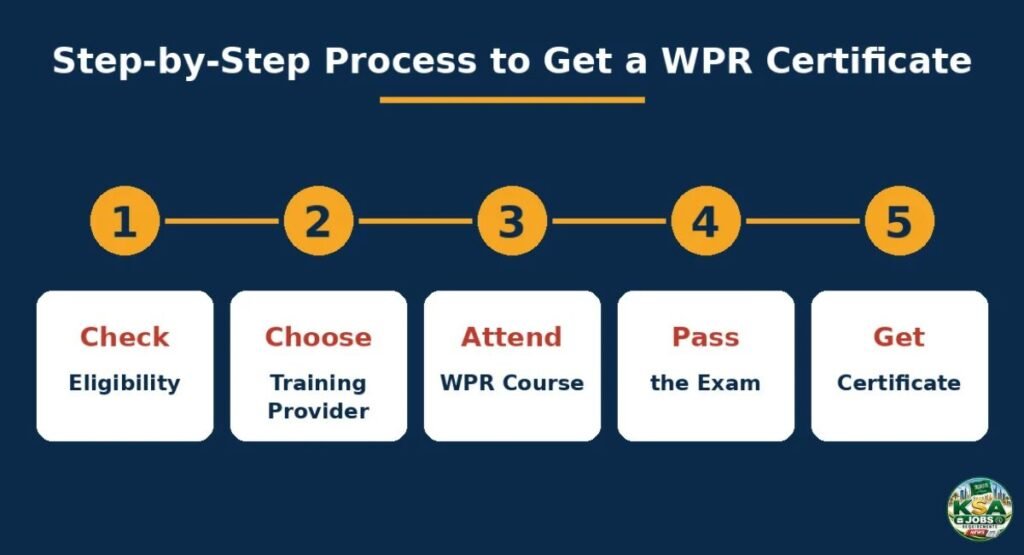
The process generally involves checking eligibility, completing prerequisite training, arranging the appropriate certification course and examination, and confirming the required certification or authorization.
The exact administrative steps can differ depending on whether the candidate is being sponsored by a contractor, employed on an existing project, or attending an approved training programme.
Step 1: Check your eligibility
Contact the training provider or your employer and explain your current job, industrial experience, and intended WPR role. Ask which prerequisites you must complete.
Step 2: Confirm the training provider
Verify that the provider is currently authorized to offer the specific Saudi Aramco WPR programme you need. Confirm the course name, examination arrangements, fees, and certificate type.
Step 3: Complete prerequisite training
Complete Hazard Recognition and Control, LOTO, and Confined Space Entry as required for your programme. Keep the completion records or certificates.
Step 4: Arrange the WPR certification course
Follow the provider’s instructions for the receiver’s certification course. Some programmes use a separate examination scheduling process.
Step 5: Pass the required assessment
Complete the required examination or competency assessment. Confirm how results are issued and what happens if a candidate needs to retake the exam.
Step 6: Confirm certification and authorization
Obtain confirmation that the required certificate has been issued and that your employer or project has completed any necessary approval or designation before you perform WPR duties.
The key distinction is that a prerequisite course certificate is not necessarily the final WPR certification. Prometric’s WPR information describes the four-day prerequisite training and the subsequent receiver certification process.
WPR Training Courses and Duration
The prerequisite training listed by National Power Academy and Prometric totals four classroom days:
- Hazard Recognition and Control: two days.
- Lock Out/Tag Out: one day.
- Confined Space Entry: one day.
The total prerequisite duration is therefore four days.
However, do not assume that four days covers every step required to obtain final WPR certification. The certification course, examination, result processing, and employer or project approval may involve additional steps.
What Will You Learn?
The course subjects are intended to help candidates understand the hazards associated with work activities and the precautions needed to control those hazards.
Candidates should be prepared to study the work permit system, hazard identification, energy isolation, confined-space precautions, and the responsibilities of people involved in the permit process.
The exact course material and assessment format should be confirmed with the provider delivering the relevant programme.
Is Online Training Enough?
Do not assume that an online course or attendance certificate is equivalent to the required certification. The cited provider information describes classroom prerequisite training and a subsequent receiver certification course.
Before paying for online training, ask whether it is formally accepted for the particular programme and whether you will still need classroom training, an examination, or project approval.
WPR Examination and Preparation
Candidates should prepare to demonstrate an understanding of the work permit system and the safety responsibilities associated with receiving permits.
The precise examination format, pass mark, number of questions, and retake policy should be confirmed with the current training provider. These details should not be assumed from unofficial social media posts.
Topics to Study
| Topic | What to understand |
| Work permit system | Why permits are used and what they authorize |
| Hazard recognition | How to identify hazards related to the work |
| Risk controls | How required precautions protect workers and equipment |
| LOTO | Why hazardous energy must be controlled |
| Confined spaces | Why entry requires specific precautions and authorization |
| Worksite inspection | Why work conditions must be checked before starting |
| WPR responsibilities | How to monitor compliance with permit conditions |
| Changing conditions | When work should be stopped and reassessed |
The work permit system requires receivers to follow the permit conditions, participate in relevant site inspections, monitor work, and stop work when conditions change in ways that require it.
Study Tips
Understand the reason behind each safety rule. Memorizing an answer without understanding the hazard can leave you unprepared for practical situations.
Review the course material carefully. Use the approved training materials and ask the instructor about any unclear procedures.
Practice workplace scenarios. Think about what should happen if the worksite changes, a new hazard appears, required isolation is uncertain, or the crew cannot follow a permit condition.
Do not rely on leaked exam answers. Unofficial question banks may be outdated, inaccurate, or unrelated to the current assessment. Learning the procedures is more useful for performing the job safely.
What If You Fail the Examination?
Ask the provider about the current retake procedure, fees, waiting period, and whether any training must be repeated. Do not assume that retesting is automatically free or available immediately.
Keep the provider’s written terms and any examination result documentation for your records.
Where to Get WPR Training in Saudi Arabia
A useful starting point is to contact providers that specifically list the Saudi Aramco contractor WPR programme. You should independently confirm their current approval and the exact programme they are authorized to deliver.
The following providers have public information about WPR prerequisite training. Their listings are starting points for verification, not a guarantee that every course or date is currently available or appropriate for every candidate.
National Power Academy
WPR course information published
The academy describes a Saudi Aramco programme for Work Permit Receiver prerequisite training and identifies a four-day programme for candidates.
Before registering, ask whether your intended course covers prerequisites only or includes the full certification process.
View WPR course information
Prometric
Training and examination information
Prometric publishes information about Contractor Work Permit Receiver prerequisite training, including the three prerequisite subjects and examination scheduling information.
Confirm the current booking procedure and whether your candidate status qualifies for the examination.
View WPR examination information
Human Assets Training Institute
The institute publishes information about contractor WPR prerequisite training, including Hazard Recognition and Control, LOTO, and Confined Space Entry.
Ask the institute to confirm its current authorization, course availability, fees, and certification arrangements before paying.
View WPR course information
Which Provider Should You Choose?
Compare providers using the same questions:
- Are they currently approved for the specific WPR training you need?
- Is the course a prerequisite programme or the final certification course?
- Does the quoted fee include the exam, or is it charged separately?
- Where is the training delivered?
- How are examinations scheduled?
- What certificate or result document will be issued?
- What are the refund and retake conditions?
A provider’s website or advertisement is not, by itself, sufficient proof of current approval. Verify the details before making a payment.
WPR Certificate Cost
The cost depends on the provider, course, examination arrangements, and the services included in the fee. There is no single price that should be assumed to apply to every candidate.
Some providers advertise a fee for prerequisite training, while others may list a combined package or a separate examination charge.
Costs to Confirm Before Registering
| Cost item | What to ask |
| Prerequisite training | Is the fee for all three required subjects? |
| Certification course | Is this included or billed separately? |
| Examination | Is the exam fee included? |
| Retake | What is the fee if you do not pass? |
| Study material | Are course materials included? |
| Travel and accommodation | Are these additional expenses? |
| Certificate processing | Are there any additional charges? |
Request a written quotation that names the course and lists all charges. Do not rely on a single advertised price if it is unclear whether the fee covers prerequisite training or final certification.
Should You Pay an Agent to Get the Certificate?
Be cautious of anyone who promises guaranteed certification, claims to have inside access to examination results, or offers a certificate without the required training and assessment.
Pay the identified provider through its verified payment process, obtain a receipt, and keep the course confirmation. Do not send money to a personal account simply because someone claims to be connected to an Aramco project.
Documents Required
The documents required can vary by provider and candidate category. Ask for the current registration checklist before submitting personal information.
Common Documents to Prepare
| Document | Why it may be needed |
| Passport or valid identification | To confirm candidate identity |
| Updated CV | To review relevant work experience |
| Employer details or nomination | May be needed for contractor or project-sponsored candidates |
| Previous training certificates | To confirm completed prerequisites where applicable |
| Relevant technical or safety certificates | If required for the course or role |
| Contact information | For registration and course communications |
This is a preparation checklist, not a universal official list of mandatory documents.
If You Are Applying From Pakistan
Before travelling to Saudi Arabia for training, contact the provider directly to confirm that international applicants can register for the exact programme you need. Ask about accepted identification, entry requirements, examination scheduling, and whether you must be sponsored or nominated by an employer.
If your goal is to get a WPR job rather than simply complete training, it is sensible to speak with potential employers first. They can explain whether they require candidates to have prerequisite training already completed or will arrange training after recruitment.
WPR Duties and Responsibilities
A Work Permit Receiver has responsibilities beyond obtaining a certificate. The role involves understanding the authorized work, checking the permit conditions, and helping ensure that the work crew follows the required precautions.
Saudi Aramco’s work permit instruction describes receiver responsibilities that include obtaining the appropriate permit from a certified issuer, participating in the joint site inspection and hazard analysis, following permit conditions, monitoring the jobsite, stopping work when conditions change, and closing permits as required.
Before Work Begins
The receiver should understand the scope of the job and the conditions stated on the permit. Relevant hazards and required precautions must be understood before the work starts.
A site inspection and communication with the permit issuer or other authorized personnel help establish whether the work can proceed under the approved conditions.
During the Work
The receiver must monitor the work and ensure the crew follows the applicable permit conditions and safety requirements. This may include checking that required controls remain in place and that workers understand the limits of the authorized activity.
The receiver must not assume that a permit remains appropriate if the task, equipment, work area, or other important conditions change.
When Conditions Change
If site conditions change or a hazard appears that affects the safe execution of the job, the work may need to stop while the situation is assessed under the applicable procedure.
Workers should not bypass a permit requirement simply to finish the job quickly. The correct response is to follow the project’s stop-work and reassessment procedures and seek direction from authorized personnel.
When Work Is Completed
The receiver must follow the required permit closeout procedure when the work is finished or when the permit expires, as applicable.
Proper closeout helps maintain accurate records and makes sure the permit system reflects the status of the work.
WPR Jobs and Salary in Saudi Arabia
WPR-related jobs may be advertised by construction contractors, industrial maintenance companies, oil and gas service providers, and other employers working on projects that use formal permit-to-work procedures.
However, there is no single salary that applies to every WPR job in Saudi Arabia. Pay depends on the employer, project, experience, technical background, working hours, and benefits.
What Affects WPR Salary?
| Factor | How it may affect an offer |
| Relevant experience | Employers may distinguish experienced workers from candidates with limited experience |
| Technical background | A WPR who also has relevant trade or supervisory experience may qualify for different roles |
| Employer and contractor | Each employer may have a different pay structure |
| Project type | Work requirements and conditions can differ between projects |
| Working hours | Shift arrangements and paid overtime can affect total earnings |
| Accommodation and food | Benefits may reduce personal living expenses |
| Contract terms | Duration, leave, allowances, and other terms affect the overall package |
These factors can influence an offer, but none guarantees a particular salary.
Does a WPR Certificate Guarantee a Job?
No. Completing training does not guarantee employment, selection by a contractor, or authorization to receive permits on a particular project.
Employers may consider experience, communication skills, safety knowledge, qualifications, current project needs, and the required certification status. A vacancy may also require a particular trade background or additional site training.
If you are looking for work, search for current vacancies using terms such as “WPR Saudi Arabia,” “Work Permit Receiver,” “Aramco WPR,” and “Permit to Work Receiver.” Verify the employer, salary, contract, and certification requirements before applying.
You can also browse Saudi Arabia job vacancies and multiple openings for related job opportunities.
Can You Apply From Outside Saudi Arabia?
You can search for vacancies from abroad, but whether a particular employer recruits candidates outside Saudi Arabia depends on its hiring needs and the vacancy requirements.
Ask whether the employer accepts overseas applicants, whether it expects candidates to hold the required WPR certification already, and who will arrange any remaining training or authorization.
Do not travel or pay an intermediary on the assumption that a certificate alone will secure a job.
How to Verify a Training Provider
Verification is important because WPR training is connected to a specific work permit system, and a general safety certificate may not satisfy the requirements for the role.
A Practical Verification Checklist
Check the exact course name. Make sure the programme is identified as the relevant Saudi Aramco contractor WPR prerequisite or certification course, as applicable.
Confirm current authorization. Ask the provider for current evidence that it is authorized to deliver the specific programme. If possible, confirm this through the relevant official or programme channel.
Ask about the final certificate. Find out which organization issues the document and whether it confirms prerequisite completion or final WPR certification.
Confirm the examination process. Ask whether an examination is required, where it takes place, how it is scheduled, and how results are provided.
Request written fees and terms. Obtain the complete cost, including training, exam, retake, and certificate processing charges.
Keep your records. Save registration confirmation, payment receipts, course completion records, examination results, and the certificate issued to you.
Warning Signs
Be careful if a provider or agent:
- Promises a guaranteed pass.
- Offers a certificate without the required training or assessment.
- Refuses to identify the course or issuing organization.
- Uses vague claims such as “100% Aramco approved” without verifiable details.
- Pressures you to pay immediately.
- Requests extra payments to secure a job after training without a clear, verifiable process.
A professional-looking website, social media page, or certificate sample does not independently prove that the programme is currently authorized.
Common Mistakes to Avoid
Mistake 1: Confusing Prerequisite Training With Certification
Completing Hazard Recognition and Control, LOTO, and Confined Space Entry may satisfy prerequisite requirements, but it should not automatically be treated as completion of the full WPR certification process.
Confirm the next step with the provider and employer.
Mistake 2: Assuming the Certificate Guarantees a Job
Training can support your application, but employers make hiring decisions based on their requirements and project needs. A certificate alone is not a job offer.
Mistake 3: Paying Before Verifying the Provider
Always check the course, provider authorization, fee, and examination arrangements before making a payment. Keep a receipt for every payment.
Mistake 4: Relying on Outdated Information
Course schedules, provider arrangements, fees, and certification processes may change. Confirm the current requirements rather than relying entirely on old advertisements, videos, or forwarded messages.
Mistake 5: Ignoring the Actual Responsibilities
WPR duties involve more than paperwork. The receiver must understand hazards, monitor the work, follow permit conditions, and respond appropriately when conditions change.
A candidate should prepare to perform the role safely, not simply aim to pass an examination.
Frequently Asked Questions
How many days are required for Aramco WPR training?
The prerequisite programme described by National Power Academy and Prometric takes four classroom days: two days for Hazard Recognition and Control, one day for LOTO, and one day for Confined Space Entry. Additional certification and examination steps may be required.
Is the four-day WPR course the final certificate?
Not necessarily. The four-day programme is described as prerequisite training. Candidates may also need to complete the receiver’s certification course, pass the required assessment, and meet applicable employer or project authorization requirements.
Can I get a WPR certificate from Pakistan?
You should ask the relevant provider whether it accepts candidates from Pakistan for the specific programme. Confirm the training location, identification requirements, examination arrangements, and whether employer nomination is required before paying or travelling.
How much does an Aramco WPR certificate cost?
The price depends on the provider and what the fee includes. Request a written quotation that separates prerequisite training, the certification course, examination, retakes, and other charges. Verify the current price directly with the provider.
Does a WPR certificate guarantee an Aramco job?
No. Certification does not guarantee recruitment or automatic authorization on every project. Employers may also consider experience, job-specific qualifications, communication skills, and project requirements.
How long is a WPR certificate valid?
The cited WPR training material states that work permit issuers and receivers must attend and pass the relevant classroom certification course every two years to maintain certification. Confirm the current validity and renewal requirements for your particular programme with the authorized provider or employer.
Final Summary
To get a Saudi Aramco Work Permit Receiver certificate, first confirm your eligibility and identify a provider authorized to deliver the specific programme you need. The published prerequisite training covers Hazard Recognition and Control, Lock Out/Tag Out, and Confined Space Entry over four classroom days. Further certification, examination, and employer or project authorization requirements may apply.
Before paying for training, confirm the course name, current provider authorization, total fees, examination arrangements, and certificate validity. Remember that completing a course does not guarantee a WPR job. Understanding the work permit system, gaining relevant experience, and following workplace safety procedures are important parts of preparing for this responsibility.
For more information, you can also check our guide on KSA Jobs Requirement
Related Reading
- Work permit receiver (WPR) salary guide
- Fire watch salary in Saudi Arabia
- How to apply for Aramco contractor jobs
